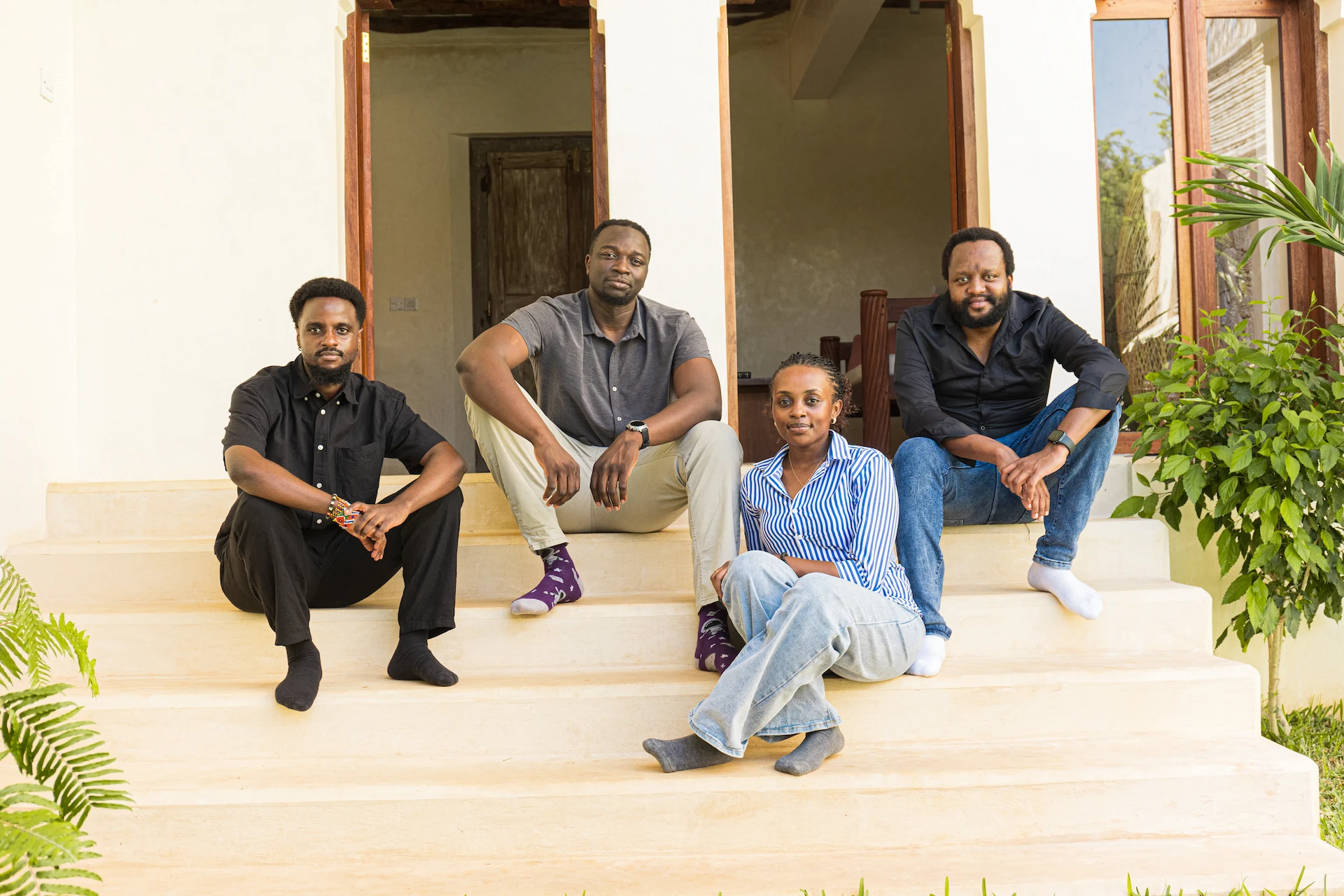
1: How did TLCOM first meet the founders
What struck us from our first conversations with Rama Afullo, the founder and CEO, was his clarity about how to connect satellites, cloud and AI. That is no accident. Rama spent over a decade at Tesla, Google and SpaceX. At Tesla, he launched the Powerwall in Africa. At Google, he led a 300-person global programme and the company’s partnership with Y Combinator. At SpaceX, he was a Product Manager on Starlink. There, he saw first-hand how much data and computing power goes to waste in orbit, and that no one was building a neutral layer to fix it. He teamed up with Dr Nelson Kigen Psenjen, a distributed computing PhD who contributed to NASA’s Core Flight System, to build Satlyt. A world class solution built by African founders with the potential to serve a growing global market, enabling low capex infrastructure for AI.
2: What problem is the company solving?
Space is getting crowded. There are around 16,000 active satellites in orbit today, and that number is expected to reach 60,000 by 2030. Yet the systems that make them useful are closed and wasteful. Operators pay roughly $20 per gigabyte to send data back to Earth, and around 80% of it is thrown away. More than 90% of the computing power on board sits idle. Each constellation works as its own silo, with no common way for satellites from different operators to share routes, compute or storage. Smaller operators feel this most. They pay for every ground station pass and are too lean to build their own software. We estimate this global software and orchestration market at ~$5bn by 2030.
3: What differentiates this company?
Satlyt is B2B infrastructure software. The unique value of Satlyt is that:
(i) it solves an existing problem by drastically reducing the cost of communication from satellites to ground stations, and
(ii) it solves a future problem, i.e. the elevated capex to build data centers for AI, by creating that same capability via space data centers.
It installs on satellites already in orbit through an over-the-air update, with no hardware changes, and turns each spacecraft into a node in a shared computing network. Satellites can filter, compress and analyse data before sending it down, cutting downlink volumes by up to 85%. Operators can also earn money from idle compute. Operators can process data closer to where it is collected, while application developers gain a way to run their software in orbit. Because Satlyt works across any hardware and any operator, it stays neutral, which matters to governments that want control over where their data goes. Traction is strong for its stage. Satlyt is live on several third-party satellites, with more missions confirmed for 2026, 30+ operator MOUs signed, a NASA STTR award, and an invitation from NASA to propose an inter-satellite communications standard.
4. Why is TLCOM excited about the investment?
We believe the next few years will decide who builds the rails of the space economy, and we think Satlyt can be the neutral layer that connects it. Rama and Nelson combine rare commercial and technical depth, and they have moved remarkably fast with a lean team across the US and Nairobi. We are proud to back an African founder, with a majority-Kenyan engineering team, building infrastructure that matters globally. Satlyt has US headquarters in Sunnyvale and Africa headquarters in Nairobi, a Kenyan subsidiary, and signed memoranda of understanding with the Kenya Space Agency and Angola’s GGPEN. Their ambition is to become the default operating layer for satellites, much as Kubernetes did for the cloud. Satlyt aims to give spacecraft from different operators a shared software layer for coordinating computing, creating virtual AI data centers in space. We are excited to be the largest African investor in Satlyt’s $8m Seed round alongside Non Sibi, Launch Africa, Antler, Slauson and others. We look forward to helping the team build its commercial function, grow its engineering bench and deepen partnerships with space agencies in Africa and beyond.